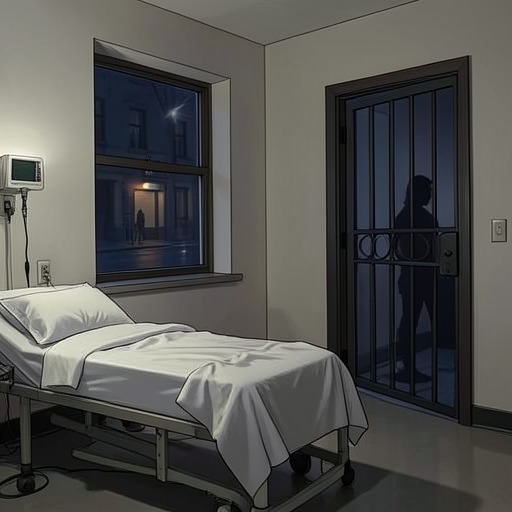
John Prince releases Mary and offers her help
Other PeopleJohn Prince’s release of Mary Lamb is a narrow escape from two forms of danger: the men who have drawn her into their company and the authorities who take her into custody. Prince recognizes her as someone he has encountered before, separates her from the people around her, and lets her leave. The encounter gives Mary her first recovered memory and establishes that, even before she can identify herself, someone else can place her within a history she has lost.
Causes and Background
Mary’s arrival in police custody follows Sharon’s reversal from companion to betrayer. The two women have been drinking together, but when Jock and Trev join them, Sharon is no longer on Mary’s side. She presents Mary to the men as simple and unlikely to object to whatever Trev wants. Her gestures of apparent friendship have therefore become part of the danger: she has brought Mary within reach of men who treat her as something to be appraised and passed between them.
The narrative makes clear that Jock and Trev are criminals, though their methods differ. Jock has made a practice of attacking vulnerable older people for money; Trev is driven by drink and fighting, and repeatedly picks fights he is not as capable of winning as he believes. Their approach to Mary is not a chance misunderstanding. Trev’s interest is threatening, and the narrator explicitly fears that Mary is unprepared for the people who have taken her up. In the later account of the men’s plans, Trev intends to return to her and inflict what the narration calls special damage. The scene in which Mary is taken away from them thus interrupts a danger that is still developing.
Taken into Custody
After Mary is rushed out into the street, she initially understands the forceful handling as another threat. The male voice accompanying her describes the procedure as routine and tells her to relax. She is led to a black bus with two men in blue suits marked with silver studs, then directed inside. Through its caged windows, sunlight enters the vehicle, a striking contrast to Mary’s confusion about what has happened and what will happen next.
On a narrow ledge inside the bus, she finds that another man is already waiting opposite her. He asks her name. Mary does not understand the question at first, and the exchange begins with her unable to supply the ordinary information that would make her legible to him. The scene briefly places her in the position of someone being processed by an authority: she has been removed from the street, is surrounded by men, and is asked to identify herself without knowing why she has been brought there. Yet this questioning turns out not to be a routine interrogation. The man’s recognition changes its direction.
Recognition and Release
The man tells Mary that he has seen her before and addresses her by her full name, Mary Lamb. He also asks what has brought her among these people, observing that they are not her kind. Mary agrees that they probably are not. Her answer does not demonstrate that she understands the larger situation; it registers her distance from the group without explaining how she came to be with them. Prince’s recognition supplies the missing connection from outside her own uncertain account.
Prince warns her to stay with her own kind and says that there will be trouble if he sees her with these people again. The warning makes his action deliberately qualified: he does not simply reassure her or pretend the danger has disappeared. Nevertheless, he then directs Dave to let her go, asserting that Mary is not one of the people in the group. The release is immediate and practical. The same encounter that begins with Mary under the control of men on a bus ends with Prince using his position to separate her from the people who have endangered her and send her away.
Memory and Significance
Mary walks erectly down the street, with the sense of being watched still upon her. After turning a second corner, she leans against a wall and presses a hand to her forehead. The pause matters because the recognition has not yet given her a coherent account of herself; instead, a specific sensory association breaks through. Prince’s breath recalls the person who was with her when she woke in the hospital’s white room, asked whether she was all right, and told her to be good. Mary remembers that earlier presence and resolves to try her best. The recovered memory is modest in content, but it confirms that her life did not begin with waking in the hospital.
The scene therefore joins rescue to recognition without making either complete. Prince can identify Mary and release her, but the novel does not turn this brief intervention into a full explanation of her past. Mary leaves with one memory restored, while Prince remains a figure whose connection to her is only beginning to emerge. The contrast between his deadened breath and the living breath she perceives in everyone else further distinguishes him from the men around her and marks the encounter as an unsettling link to what she cannot yet remember. His intervention changes her immediate circumstances; the memory it awakens changes the meaning of her lost identity.